

Growth is a good thing, especially for property management firms that are expanding their portfolios, adding new communities, and increasing overall revenue. At the same time, growth tends to introduce a level of complexity that is easy to overlook at first but becomes harder to ignore.
In the early stages, everything still feels manageable. Teams adapt to new tools, processes evolve as needed, and small inefficiencies are easy to work around. As the organization continues to scale, however, those small adjustments begin to accumulate, and what once felt flexible can start to feel fragmented.
This is typically the point where companies begin looking more seriously at their property management systems, and the broader property management technology that supports them, not because something has failed outright, but because things no longer run as smoothly as they should.
Where Things Start to Get Complicated
The shift rarely happens all at once, and in many cases, it is difficult to pinpoint exactly when things started to feel more challenging.
Instead, it tends to show up in subtle ways. Teams begin spending more time tracking down information. Reports take longer to pull together and are sometimes inconsistent depending on the source. Communication between offices feels less streamlined, particularly when different tools or systems are involved.
A few common patterns start to emerge:
- Different offices using different property management systems or tools
- Reporting processes that feel slower or less reliable than before
- Teams relying on manual workarounds to fill gaps between systems
- Security becoming more difficult to manage across locations
- IT teams spending most of their time responding to issues instead of improving systems
None of these issues are critical on their own, but together they create a level of friction that affects how efficiently the entire organization operates.
Why This Happens (Even When Decisions Make Sense)
This kind of complexity is not the result of poor planning or bad decisions. It is simply a byproduct of growth.
Property management companies typically build their technology environments based on immediate needs, which is both practical and necessary. When a new property is added, a system is introduced to support it. When an acquisition occurs, existing tools are often maintained to avoid disrupting operations. When a specific problem arises, a targeted solution is layered into the workflow.
Each of these decisions makes sense on its own.
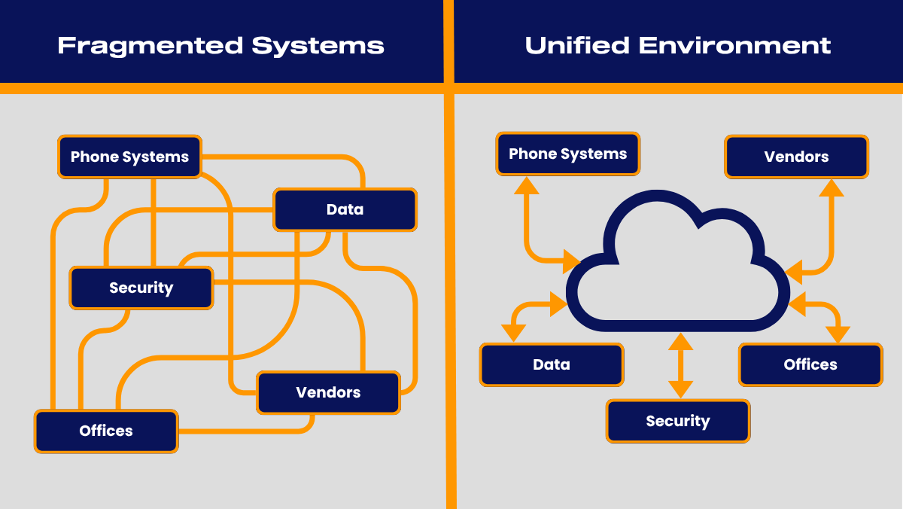
Over time those decisions begin to stack, resulting in a mix of property management systems, vendors, and processes that no longer align as cleanly as they once did.
What started as a flexible approach gradually turns into an environment that is harder to manage, harder to secure, and harder to scale.
What Effective Property Management Systems Actually Look Like
Addressing this kind of complexity does not require a complete overhaul, and in most cases, starting from scratch would create more disruption than value. Instead, the focus tends to be on bringing structure and alignment to what already exists.
Organizations that navigate this transition successfully usually concentrate on a few key areas.
First, they reduce unnecessary system sprawl by standardizing on a smaller number of core platforms, which makes it easier for teams to work consistently across offices and departments. Second, they prioritize making data more accessible and reliable so that leadership can make decisions based on a clear and unified view of performance.
Security also becomes a central focus, particularly as the organization grows and handles more sensitive information across a wider footprint. Rather than treating security as an afterthought, it becomes an integrated part of the overall property management technology environment.
Most importantly, IT evolves from a reactive support function into a proactive driver of stability, focused on enabling sustainable, long-term growth.
These are the elements that define strong, scalable property management systems, even though implementing them in a live environment requires careful planning and execution.
A Real-life Property Management System Example
We recently worked with a property management company that had reached a point where their existing property management systems were no longer keeping pace with their growth.
Over the course of roughly four years, they had expanded their portfolio significantly, which resulted in a mix of systems and vendors that did not fully integrate with one another. Communication between offices was inconsistent, reporting lacked clarity, and their security posture needed to be strengthened to match the scale of the organization.
Importantly, nothing had completely broken. The business was still operating, and teams were finding ways to get their work done. However, it was becoming increasingly clear that the environment was more difficult to manage than it needed to be.
Rather than continuing to address issues individually as they arose, the company took a step back and focused on simplifying and aligning their property management systems.
This involved consolidating communication tools, improving how data was accessed and used, and strengthening their overall security framework. While these changes were not necessarily dramatic on the surface, they had a meaningful impact on day-to-day operations.
Communication became more consistent across teams, leadership gained clearer visibility into performance, and security improved in a measurable way. At the same time, costs that had gradually increased over the years began to come down as systems were streamlined.
The environment became easier to manage, which allowed the organization to continue growing without adding unnecessary complexity.
The Bigger Picture
For property management companies that are scaling quickly, some level of complexity is inevitable, but the long-term impact depends on how that complexity is managed.
When property management systems and related property management technology remain fragmented, the effects extend beyond IT and begin to influence how efficiently teams operate, how confident leadership feels in the data, and how easily new properties or offices can be integrated into the business.
On the other hand, when property management systems are aligned and supported by the right property management technology, the organization benefits from greater consistency, clearer visibility, and a more stable foundation for future growth.
Effective property management systems go beyond addressing short-term challenges and instead create a foundation that supports smoother operations and long-term growth.
Want to See Exactly How This Was Done?
We have put together a detailed breakdown of this project that walks through the full process, from the initial challenges to the approach used to simplify and align the environment.
Inside the case study, you will find:
- A closer look at the original technology environment
- The strategy used to consolidate systems and improve alignment
- The Microsoft tools and solutions involved
- The measurable results that followed
Frequently Asked Questions
What are property management systems?
Property management systems refer to the systems, tools, and strategies that support communication, operations, data management, and security within a property management organization. These systems are a core part of the broader property management technology environment and are often evaluated and optimized by providers like Sparta Services to ensure they scale effectively.
Why do property management companies face IT challenges as they grow?
As companies expand, they often add new systems and inherit existing ones through acquisitions, which can lead to fragmented property management systems and disconnected property management technology, making operations less efficient over time.
What are the most common technology challenges in property management?
Common challenges include disconnected systems, limited visibility into data, manual processes that slow teams down, and increasing cybersecurity risks across multiple locations. These are the types of challenges Sparta Services frequently helps property management organizations address as they grow.
How can property management firms improve their IT environment?
Improvement typically involves simplifying and standardizing property management systems, centralizing data, strengthening security practices, and aligning overall property management technology to support long-term growth. Many organizations take a structured approach with guidance from firms like Sparta Services to ensure changes are implemented without disrupting operations.
When should a company consider modernizing its IT systems?
Organizations should consider modernization when growth begins to introduce inefficiencies, when data becomes harder to access or trust, or when IT teams are spending more time reacting to issues than improving systems.

Dave Galy
Dave Galy is the founder and CEO of Sparta Services
